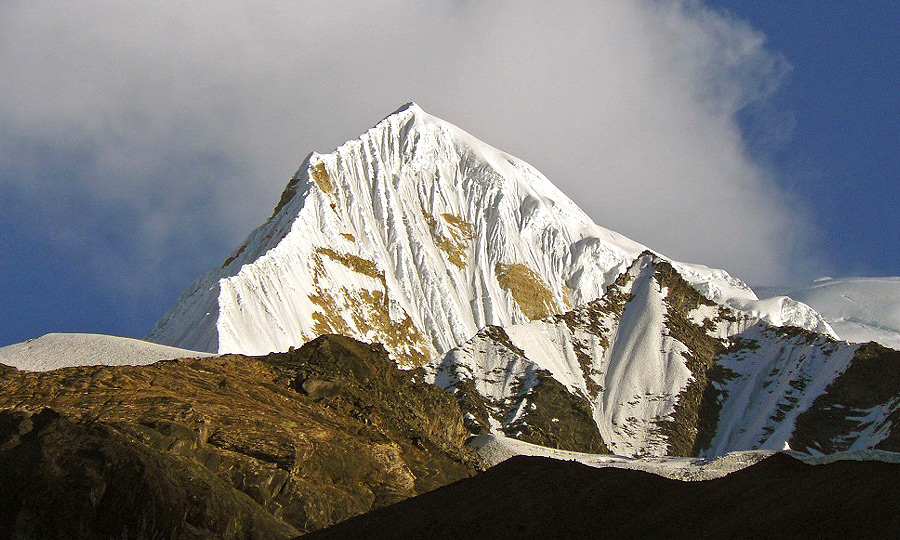
Singu Chuli formerly known as Fluted Peak is the 3rd highest among the "Trekking Peaks" of Nepal and situated in the Annapurna Sanctuary adjoined to Tharpu Chuli and across Hiunchuli trekking peaks placing a privileged, splendid amphitheatre of glaciers and nodes with, in background the mythical southern face of Annapurna. This peak is really an attractive and compared its beauty with India's highest and probably the most beautiful peak, Nanda Devi but difficult, one that has proven too difficult for commercial climbing groups. There are a number of different routes on the mountain with ice-falls.
This trek is strongly recommended for excellent mountain views. You will enjoy the great cultural diversity in the Ghandruk-Chhomorong, Ghorepani. Before entering the Fish Tail (Machhapuchhare Base Camp) and Annapurna Base Camp, you can enjoy the panoramic views of the world's highest mountains.
This trek is suggested do be done carefully between cultivated hills and terraces, marked out by prosperous Gurung village. From the base Camp of Machhapuchhre, we will head full north towards the valley to arrive at the base camp of Singu Chuli. Some vertical walls near the summit pose some technical challenge on this climb. This climb is suggested to only participants with some alpine experience.
On your arrival at Kathmandu International Airport, you will be greeted with flower garlands/Khadas. Our representative will then take you to your hotel. If time prevails, you will visit office for paperwork.
Stay overnight at the hotel in Kathmandu.
Today, you will visit popular world heritage monuments in Kathmandu including Kathmandu Durbar Square, Boudhanath, Swoyambhunath, and Pashupatinath. Alternatively, you can also choose Bhakatapur and Patan sightseeing. By late afternoon, you will drive back to your hotel.
Stay overnight at a hotel in Kathmandu.
After early morning breakfast, you will be picked up from the hotel and taken to the tourist bus station. Drive from Kathmandu to Pokhara (914m.) takes about seven hours. The drive will take most of our morning time, leaving much of the afternoon to get a warm glimpse of Pokhara Valley and its beauty. If you choose to fly, you can reach Pokhara in 25 minutes. There are several flights from morning to afternoon available from Kathmandu to Pokhara.
Pokhara is the tourist's paradise with full of natural as well as cultural heritage sites such as lakes, caves, Buddhist monasteries and Hindu temples along with the magnificent views of Lamjung Himal, Annapurna, Dhaulagiri and many other mountain peaks.
Stay overnight at hotel in Pokhara.
After breakfast, you will drive from Pokhara (915 m.) to Phedi (1130 m.) takes about 30 minutes and trek from Phedi to Pothana (1990m.) takes about four hours.
From Phedi you begin your trek to Pothana (1900m), which is a small Gurung village surrounded by pine and rhododendron forests. You can see close up views of Lamjung and Annapurna Himal. The trail ascends all the way to Pothana through forests till you reach the village called Dhampus. It is a Gurung village with magnificent views of Annapurna ranges, Lamjung Himal and Manaslu.
Stay overnight at lodge.
While trekking from Pothana to Jhinudanda the trail ascends gently to Deurali and further to Bherikharka through forested path. You then follow a flat path till you arrive at Landruk village. The path you follow include terrace fields and numerous green hills till Landruk and this section is really exhilarating as you pass through many local villages rich in culture. From here the trail descends to Modi Khola (stream) and ascends gently all the way to Jhinudanda.
Stay overnight at lodge.
The trail is steep up through terraces from Jhinudanda to Chhomrong. Passing Chhomrong, the trail descends along a stone staircase and crosses the Chhomrong Khola on a wooden bridge, then climbs out of the side valley. High above the Modi Khola on its west bank, the trail passes through the tiny settlement of Bhanuwa in forests of bamboo and terrace fields and passing through a few small settlements. Climbing further through a rocky trail you reach three hotels at Sinuwa, at 2350m. We keep on climbing through rhododendron forests to Kuldi Ghar (2520m). This was once a location for British sheep breeding project. In winter, it's common to find snow anywhere from this point on. Descend a long, steep stone staircase into deep bamboo and rhododendron forests. It is then a short distance on a muddy trail to Bamboo Lodge (2340m.).
Stay overnight at lodge.
The first town you reach is Dovan (2630m.) where there are few lodges and camp sites. Now you pass through muddy trail which traverses high above the river. It takes approximately twenty minutes to reach Deurali (3230m.)
Stay overnight at lodge.
Trek from Deurali to Machhapuchhare Base Camp (3820m.) takes about three hours.
Stay overnight at lodge.
Today, you will trek from Machhapuchhare Base Camp to Annapurna Base Camp (4170m) and back to Machhapuchhare Base Camp.
Stay overnight at lodge.
Trek Machhapuchhare Base Camp to Yak Kharka (4400 m) takes about 6 hours.
Stay overnight at lodge.
Trek/climb to Singu Chuli Base Camp (4700m) takes about 6-7 hours.
Stay overnight at camp.
Rest day at Singu Chuli Base Camp.
Stay overnight at camp.
Climb to Singu Chuli High Camp (5200m) takes about 4-5 hours.
Stay overnight at camp.
Climb from Singu Chuli High Camp to Camp I (5500m) takes about 5-6 hours.
Stay overnight at camp.
Today, you will climb to Camp II (5800m) that takes about 4-5 hours.
Stay overnight at camp.
Summit Singu Chuli peak (6501m) and descend down to Singu Chuli Base Camp.
Stay overnight at camp.
Trek down to Machhapuchhare Base Camp takes about 6 hours.
Stay overnight at lodge.
Trek from Machhapuchhare Base Camp to Bamboo takes about five hours. Now you trek through Himalayan Hotel to Bamboo.
Stay overnight at lodge
The trail goes steeply up to the Kuldi Ghar and now the trail is quite flat until you reach Sinuwa. The trek then gradually descends to the Chhomrong Khola and you have to follow stone staircase for almost an hour to reach Chhomrong. 1 hr further down will take you to Jhinu Danda. You can visit a natural hotspring in Modi Khola, which is 20 minutes hike from Jhinu Danda.
Stay overnight at lodge.
Trek from Jhinudanda to Ghandruk (1940m) takes about 4 hours and drive from Ghandruk to Pokhara via Nayapul takes 3 hrs.
The trail gradually descends for sometime before ascending to Ghadruk Kot. Now, you walk for almost twenty minutes through flat path up Ghandurk village. Ghandruk is one of the most popular Gurung villages in Annapurna region from where you can enjoy views of Annapurna, Macchapuchre and Hiunchuli. You can t drive from Ghandruk village to Pokhara via Nayapul (New Bridge). The one and a half hour stretch from Ghadruk to Nayapul is over a graveled road and the next one and a half hours to Pokhara is along paved road.
Stay in hotel in Pokhara.
After breakfast early morning, drive from Pokhara to Kathmandu that takes about seven hours. While driving from Pokhara to Kathmandu, you pass through Damauli, Dumre, Muglin and finally Kurintar where Nepal's first Cable car is operated to reach to Manakamana Temple. En route, you will enjoy the mountain views, green sceneries, rice terrace fields, vegetable fields and people being engaged in their daily life activities. Leaving Kurintar you head towards Thankot via Naubise. Thankot is the entry point to Kathmandu. If you choose to fly back to Kathmandu, it takes about 25 minutes. There are several flights from Kathmandu to Pokhara from morning to afternoon.
Stay overnight at hotel in Kathmandu.
As per your flight schedule, our airport representative will transfer from your hotel to the airport for your final departure.
Singu Chuli is considered one of the most challenging trekking peaks in Nepal. While it doesn’t require an expedition permit like the 8,000-meter giants, don’t let the “trekking peak” label fool you—it’s a technical climb.
Climbers must navigate through steep snow and ice slopes, glacier travel, and ice walls that may require fixed ropes and advanced climbing techniques. The final summit push involves some steep, exposed sections that demand proper mountaineering experience. This climb is not for beginners, and anyone attempting it should be well-versed in the use of crampons, ice axes, and rope systems.
Absolutely, yes. Singu Chuli is not a peak for novice climbers. While it doesn't require you to be an elite alpinist, you should be comfortable with:
- Walking on glaciers using crampons
- Using an ice axe
- Rappelling and ascending fixed ropes
- High-altitude trekking (over 5,000 meters)
If you’ve previously climbed peaks like Island Peak, Mera Peak, or Lobuche East, you’ll be in a good position to tackle Singu Chuli. It’s ideal for climbers looking to step up their game before attempting even higher or more technical mountains.
The best seasons to climb Singu Chuli are:
- Spring (March to May) – Stable weather, warmer temperatures, and lush landscapes make this a great season. The trails are vibrant with blooming rhododendrons, and the visibility is usually excellent.
- Autumn (September to November) – This is considered the prime climbing season in Nepal. Clear skies, minimal precipitation, and calm winds at high altitudes make it a favorite among mountaineers.
Climbing during the monsoon (June–August) or winter (December–February) is discouraged due to the risks posed by snow accumulation, avalanches, and unstable weather.
To climb Singu Chuli, you’ll need a combination of trekking and climbing permits. These include:
- Climbing Permit from the Nepal Mountaineering Association (NMA)
- Annapurna Conservation Area Permit (ACAP)
- TIMS Card (Trekkers' Information Management System)
All of these are typically arranged by your trekking/climbing agency. It’s important to go through a registered operator, as independent climbing is not advisable or often not allowed due to safety protocols.
The cost can vary widely depending on the expedition’s length, services, and guide quality. In general, you can expect to pay between $2,500 and $4,000 USD for a fully supported climb. This price typically includes:
- Permits and fees
- Domestic flights or transport
- Guide and porter services
- Tented camping above base camp
- Accommodation and meals during the trek
- Climbing gear rental (if not bringing your own)
Additional expenses may include personal insurance, tips, snacks, extra nights in Kathmandu or Pokhara, and emergency evacuation (which is why travel insurance is a must).
Training is crucial for a safe and successful climb. You'll need a mix of cardio fitness, strength training, and mountaineering-specific skills. A good prep plan includes:
- Cardiovascular endurance: Running, hiking, or cycling for several hours per week
- Leg strength: Squats, lunges, and stair climbing with a loaded backpack
- Altitude training (if possible): Simulate exposure using high-altitude gyms or by taking smaller climbs
- Technical practice: Learn rope handling, crampon use, and ice axe techniques either in your home country or at a training camp
Start training at least 3–4 months before the climb.
Yes, altitude sickness is always a risk on any peak above 3,000 meters, and Singu Chuli goes well above 6,000 meters. Symptoms of Acute Mountain Sickness (AMS) include headache, nausea, fatigue, and dizziness.
To reduce risk:
- Follow a gradual acclimatization schedule
- Stay hydrated
- Avoid alcohol and smoking during the trek
- Climb high and sleep low when possible
- Know the signs and descend if symptoms worsen
Reputable guides will monitor your health closely and ensure proper acclimatization.
Mountaineering Equipments
Crampons, Ice axe, Helmet, Harness, Lock and unlock Carabineers, Shovel, Climbing pack, Rope, Ski poles, Desender/abseil device, Jummer (Asender) , Tapes, Prusik Loops, Rappel device, Hand Warmer (if possible)
Clothing and Wears
Trekking shoes with spare laces, Mountaineering Boots, Plastic or leather for mountaineering boots, Gore-Tex pants, Long shorts, Insulated Parka, Jumper, Waterproof Jackets, Down Jacket, Fleece Vest, Wool cap, Neck Gaiter, Gloves, Climbing Socks, Thermal Underwear, Sandals, Snow Goggle
Essential Gears
Backpack, Duffle bag, Sleeping Bag, sleeping pad, Tents
Gadgets
Map, Compass, Camera, GPS, Two way radios, Binoculars, Head Lamp, Flashlight
Sun Protection Items
Sun glasses, sun scream, Lip balm
Medical
First aid Kit (Brufen / Ibuprofens, Antibiotic, Diamox, Paracetamol, Handy Plaster, Crack Bandage, Tincture Iodine, etc.)
Other Essentials
Energy Bars, Water bottle, Water Purification Tablets, Toiletries, Trekking poles, Pocket knife, raincoat, Satellite Phone, Altimeter
Nepal 18 Days
Nepal 27 Days
Nepal 21 Days
Nepal 17 Days
Nepal 19 Days
Nepal 21 Days
Nepal 33 Days
Nepal 20 Days
Nepal 26 Days
Nepal 23 Days
Nepal 13 Days
Nepal 22 Days
Nepal 16 Days