Annapurna Circuit Trek is one of the most popular treks in the famous Annapurna region, situated in northwestern region of Nepal Himalaya. As the name has it, Annapurna Circuit trek completely encircles the Annapurna Himalayan range including Annapurna I (8091m), tenth highest mountain in the world.
The Annapurna Circuit trek offers a rare mix of pure adventure, pristine nature and wildlife. The trek covers enchanting landscape of Marshyangdi and Manang valley which are well above 3000m from sea level and explores Annapurna conservation area. The barren landscape of Manang actually reaches out to Tibet with the people here following Tibetan Buddhist, culture and dialect. You will enjoy superb views of Manaslu, Annapurna II, Lamjung Himal, Pisang Peak, Annapurna III & IV and Gangapurna among others.
The high point and the most challenging feat of this trek is the crossing of Thorong La (5416m), one of the highest Himalayan passes before descending down to Kali Gandaki valley to Kagbeni and Jomsom. The world's deepest gorge, the Kali Gandaki gorge is also here. You will also experience the culture and customs of Thakali community, who are known for their astute trade skills delicious delicacies.
Unlike the old times, Annapurna Circuit is no longer considered a long trek. There is now a motorable road that takes you all the way to Muktinath, thereby shortening trekking time. However, trekking can still be done which can easily be combined with ride. Motorable road means there is no need for acclimatization and you have option to make shorter trek.
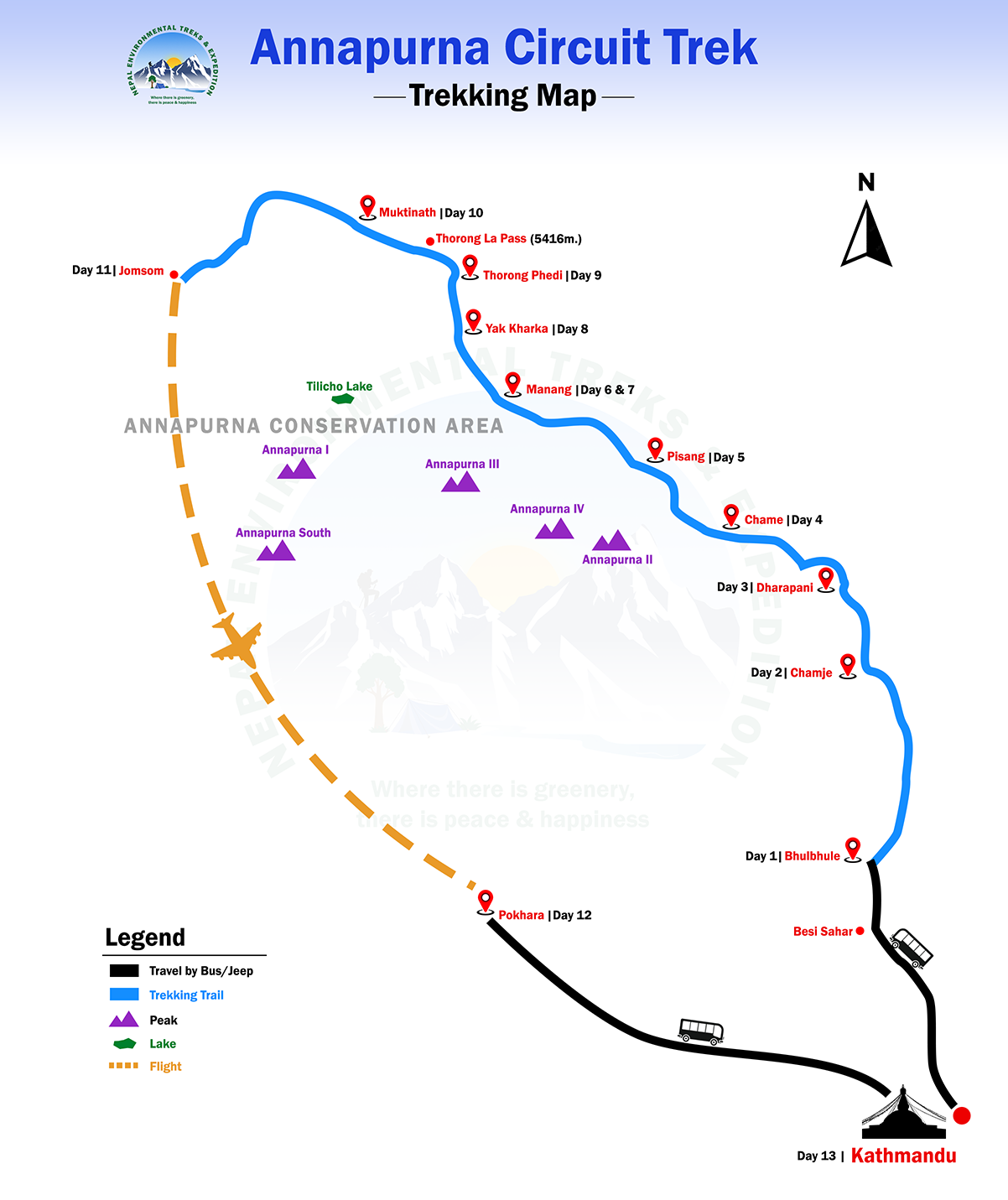
Enjoy early morning breakfast, then drive from Kathmandu to Bhulbhule via Besisahar that takes about seven hours. The journey follows Trisuli and Marshyangdi Rivers passing through several villages while you will enjoy views of green hills and snowcapped mountains. The road from Kathmandu to Besisahar is paved while rest of the journey to Bhulbule is on a graveled path. Stay overnight at lodge.
The trail takes you into the Marshyangdi valley as you follow the winding mountain path down to Syange (1100m). Afterwards climb steeply through sheer cliff-face some 200-300m above the riverbed to reach Chamje. Stay overnight at lodge.
The first part of the trail winds down to the Marshyangdi River and then crosses a suspension bridge for a steep climb to Sattale (1550m). From here the trail descends to a grassy riverbank that leads to the village of Tal (1700m). Beyond Tal, the trail goes around windy cliffs, passes through Karte village and finally comes to the Mani entrance to Dharapani (1960m.). Stay overnight at lodge.
Today the trek goes along the Dudh Khola that originates from the south face of Mt. Manaslu. You will soon arrive at the village of Bagarchhap, distinct with its prayer flags and a Buddhist monastery. Continue to climb through forests of pine and oak to reach Danaque (2210m.) and thereafter the trail levels all the way to Chame where there are government offices, shops and hotels. Chame is the administrative headquarters of the Manang district. Stay overnight at lodge.
After watching Lamjung Himal (6893m) sparkling in the morning sun, you will climb the path up the valley, passing a huge apple orchard. The trail then enters fir and pine forest, and emerges out to a high, rocky cliff which is extremely steep leading to Bhratang (2950m.). You will now walk through a short stretch of pine forest as the path opens up to a wonderful vista of Annapurna II and Pisang Peak (6091m). Ahead follow a long section of Mani wall to enter the village of Pisang. Stay overnight at lodge.
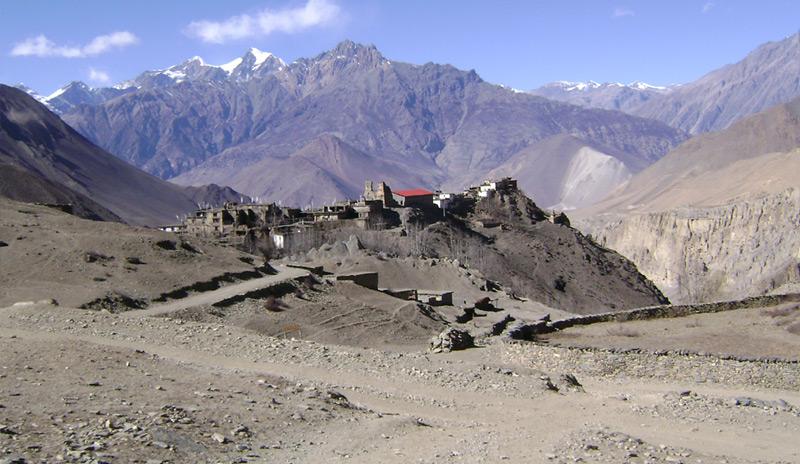
Leaving Pisang in the morning, the trail ascends a steep ridge that offers good views of the Manang valley and Tilicho peak (7145m). When descending to Hungde (3320m), you will come to a wide plain of the Sabje Khola Valley from where the north-east face of Annapurna III and Annapurna IV (7525m) rises majestically. Afterwards you will cross Marshyangdi Khola over a wooden bridge that takes you to the tiny village of Mungji. Mungji has large Chortens and mani walls and is surrounded by towering peaks of Annapurna II, Annapurna III, Annapurna IV, Gangapurna (7455m.) and Tilicho Peak (7145m.). A short steep climb from Mungji will reach you Manang. Stay overnight at lodge.
Today is a rest day for acclimatization in preparation of crossing the Thorung La Pass. You can choose to cross the river to see the tremendous icefall coming down from the Annapurna or climb high above the village for majestic views of the Annapurna range and the Manang Valley. Stay overnight at lodge.
Today the trail ascends gently all the way to Yak Kharka passing through Gunsang village (3960m). En route, you can see panoramic mountain views all day long. Stay overnight at lodge.
Leaving Yak Kharka, you will climb gradually to a ridge before descending to the headwaters of Marshyangdi. After a short ascent along the river bank, you will follow a narrow trail across an unstable spree slope and then descend to Thorung Phedi. Stay overnight at lodge.
You will start the trek very early in the morning. The trail is long, steep and challenging all the way to the Thorong La pass. After around 4 hours of steady climbing on moraines, you will arrive at the Thorong La pass which is adorned with chorten and prayer flags. Thorong La pass is one of the highest passes in the Annapurna region and offers great views of the valley below. From Thorang La pass, the path descends along the Jhong Khola Valley towards Muktinath. Muktinath is one of the most sacred pilgrimages in the Himalaya for both Hindus and Buddhists. Stay overnight at lodge.
Today the trail mostly descends all the way to Jomsom. This is an easy and pleasant trek. Jomsom is a popular town based on the bank of Kali Gandaki River and is the starting point of Upper Mustang trek. Stay overnight at lodge.
The flight is a scenic one with panoramic views of Himalayan peaks, especially Annapurna, Dhaulagiri, Nilgiri etc. as well as Kaligandaki River. The flight to/from Jomsom occurs only in the morning because of high intense wind during afternoon. In case of cancellation of flights due to bad weather, you can choose to drive from Jomsom to Pokhara takes about 7 hrs. Stay overnight at hotel in Pokhara
After breakfast early morning, you will prepare for a day long ride from Pokhara to Kathmandu. During the highway journey, you will enjoy the mountain views, green sceneries, rice terrace fields, vegetable fields and people being engaged in their daily life activities. If you choose to fly back to Kathmandu, it will only be about 25 minutes. Daily flights takes place from Kathmandu to Pokhara throughout the day.
This is a shortened version of the classic Annapurna Circuit trek. It follows the traditional route from Besisahar through Manang, Thorong La Pass (5,416m), and Muktinath, ending in Jomsom, where you catch a flight back to Pokhara.
By flying back, trekkers skip the final days of walking along the road-accessible Kali Gandaki Valley (between Jomsom and Tatopani), which is less scenic due to increased vehicle traffic. It’s ideal for those who are time-conscious or want to avoid the dusty trails.
The total trek usually takes around 12 to 15 days, depending on your pace and acclimatization schedule. Here's a sample breakdown:
a. 6–8 days to reach Manang from Besisahar
b. 2–3 days to cross Thorong La and reach Jomsom
c. 1 buffer/rest/acclimatization day (often in Manang)
d. 1 day to fly from Jomsom to Pokhara
This makes it one of the most efficient ways to experience the Annapurna Circuit's best parts.
The highest point is Thorong La Pass, sitting at 5,416 meters (17,769 feet). This is the most physically demanding section due to the high altitude, cold temperatures, and steep ascent. Proper acclimatization and preparation are critical for a safe and enjoyable crossing.
The trail from Jomsom to Tatopani and beyond is now connected by road, which has significantly changed the trekking experience in this section.
Benefits of flying back include:
Saving time: You skip 3–4 days of descent.
Avoiding dust and traffic: The road is used by jeeps and buses.
Comfort: The flight to Pokhara is scenic and takes only about 20 minutes.
Energy conservation: Great if you're tired after the pass.
A popular itinerary might look like this:
- Besisahar (start point)
- Trek to Chame, Pisang, and Manang
- Rest/acclimatization day in Manang
- Trek to Yak Kharka, Thorong Phedi, and then Thorong La Pass
- Descend to Muktinath and continue to Jomsom
- Fly to Pokhara
This itinerary covers the most scenic and culturally rich parts of the Annapurna Circuit without the additional days of road walking.
Flights are available daily, weather permitting. However, Jomsom is known for unpredictable strong winds and frequent delays, especially after mid-morning.
Tips:
- Book early, especially in peak season (March–May, Sept–Nov)
- Take the first morning flight (usually around 6:30–8:00 am) for the best chance of flying
- Have one extra buffer day in case of cancellations
- Carry light: Small planes have luggage limits (~10kg check-in, 5kg hand-carry)
Yes. If the flight is canceled or you're feeling adventurous:
a.Take a shared jeep or local bus to Pokhara (takes 10–14 hours)
b. Trek down to Tatopani, Ghorepani, and Nayapul for a few more days of hiking (adds 4–5 days)
However, this section includes long, dusty roads, so most people prefer to fly or drive.
You need two permits:
a. ACAP (Annapurna Conservation Area Permit) – NPR 3,000 (~$25 USD)
b. TIMS Card (Trekkers' Information Management System) – NPR 2,000 (~$17 USD)
Permits can be obtained in Kathmandu or Pokhara, either independently or via a trekking agency.
As of 2023, hiring a licensed guide is mandatory for solo trekkers.
Altitude is a serious consideration, especially when crossing Thorong La.
Key preparation tips:
- Spend 2 nights in Manang (3,540m) for acclimatization
- Consider hiking up to Ice Lake or Gangapurna Lake during rest days
- Stay hydrated, ascend gradually, and listen to your body
- Carry Diamox (acetazolamide) if you're prone to AMS (consult your doctor first)
- Symptoms of Acute Mountain Sickness (AMS) include headache, nausea, fatigue, and dizziness — descend if symptoms worsen.
Teahouses along the Annapurna Circuit are simple but comfortable. They usually offer:
- Basic twin rooms (blankets provided, but bring a sleeping bag)
- Communal dining areas with heating (often via yak-dung stoves)
- Toilets (shared, squat or Western-style depending on location)
- Wi-Fi and hot showers (available at extra cost in many places)
- In higher areas like Yak Kharka or Thorong Phedi, facilities are more limited and basic.
Yes, but it varies:
Lower regions (Besisahar to Manang): decent mobile signal (NTC or NCELL), paid Wi-Fi available in most teahouses
Higher regions (Yak Kharka to Thorong La): limited or no signal
Jomsom: good signal and Wi-Fi
Buy a local SIM in Kathmandu or Pokhara if you want better access — NTC tends to have wider coverage in the mountains.
Because you’re flying out, you can pack lighter without worrying about the long return walk. Key items:
Clothing: Base layers, mid-layers, down jacket, waterproof shell, gloves, beanie, trekking pants
Gear: Sleeping bag (rated to -10°C or lower), water purifier/tablets, trekking poles, headlamp
Essentials: First-aid kit, power bank, sunscreen, sunglasses, snacks
You can rent or buy gear in Kathmandu or Pokhara. Porters carry up to 15–20kg, so pack smart.
Absolutely. Your insurance must cover:
a. High-altitude trekking (above 5,000m)
b. Helicopter evacuation
c. Medical care and repatriation
Keep a copy of your policy, and make sure your guide knows your insurance provider in case of emergency.
- Start early each day to avoid afternoon winds and crowds
- Cross Thorong La before 8:00 am if possible (it’s cold and windy later)
- Bring cash — there are no ATMs after Besisahar, and teahouses don’t accept cards
- Be respectful of local culture (ask before taking photos, dress modestly)
- Pack light but be prepared for cold weather above 4,000m
Below is a list of equipment and clothing required for trekking. The necessity of these items depends on the type, altitude, timing and destination of trekking. Appropriate trekking gears are not only required for the comfort/pleasure of your trek but also to improve safety factor. Please have a look over these items in order to fully prepare and thoroughly enjoy the trekking.
General Items:
Daypack, Rucksack, Sleeping bag, Duffel bag, Walking Poles, walking boots, sandals, Toiletries (Soaps, Toilet papers, Sanitizers, toothpaste, tooth brush, etc.)
Clothing Items:
Thermal underwear, Down jacket, Shorts, Trekking trousers, Towels, Woolen gloves, Gaiters, Fleece jacket or Pullover, Wind/water proof jacket, Raincoat, Warm socks, buff
Sun-worn Items:
Sun hat, Sunglasses, Snow goggles, Sunscreen, Lip balm
Gadgets:
Headlamp, Flash light, Binoculars, Cameras (chargers and batteries),
Liquid/Snacks:
Water bottle/bladder, Water purification Iodine tablets, Energy bars and snacks
Medical Essentials:
First Aid Kit
Optional:
Altimeter, Compass, Binoculars, Books/magazines, GPS, Pocket knife, Candles (for lodges), Notebook with pencil/pen, etc
Additional items for camping trek:
Tent, Stove and fuel, Utensils for cooking, eating and drinking, sleeping mattresses
Note: We can also provide sleeping bag, down jacket, duffel bag, walking poles, and First Aid Kit in case if you don’t have one. These items are inclusive of total package price.
Nepal , Wilderness Trek 16 Days
Nepal , Annapurna Trek 25 Days