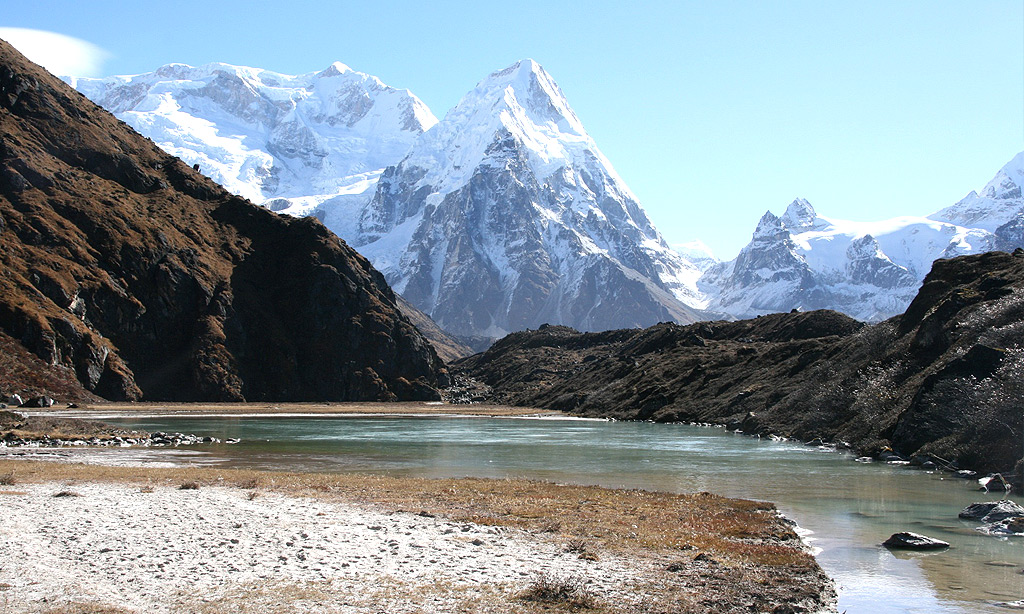
Kanchenjunga (8586m) is the third-tallest mountain in the world after Mt. Everest (8848 m) and Mt. K2 (8611m). Kanchenjunga is a word of Sikkimese origin. Indigenous people from Himalaya particularly of Darjeeling, Taplejung and Sikkim highly revere the peak as a sacred mountain. It is locally known as Sewalungma among Limbu and Rai communities in Nepal. Mountain people still believe that the mountain is the place where gods dwell which implicates their respect towards nature.
Kanchenjunga massif encompasses 16 peaks among which four are above 8000m. The mountain comprises of four glaciers covering an area of 314 sq. kilometers, and is a major source for Brahmaputra and Ganges catchments. Kanchenjunga feature narrow icy ridges spotted with smaller peaks, sloping plateau and hanging glaciers. The risk of avalanches also exists. Joe Brown and George Band successfully conquered the Mt. Kanchenjunga on May 25, 1955 and made it a historic day in the history of Kanchenjunga expedition. This team was led by Charles Evan and all other participants were from UK. The standard route and the one used in the first successful attempt follows southwest route via the Yalung Glacier. However, the north route is considered the safest, although not the easiest route to climb.
An interesting fact related to the mountain is that it has actually never been summitted. The first successful mountaineers Brown and Band stopped short of stepping foot on the top of the mountain as per the request of then Maharajah of Sikkim. The tradition has been continued ever since.
Kanchenjunga expedition was the first successful attempt made by any British over eight-thousanders. Mt. Kanchenjunga is a least climbed technical mountain despite of its comparatively low government Royalty as compare to Mt. Everest. The Royalty to climb Mt. Everest is US$11000, US$5500, and US$2750 in spring, autumn and winter/summer season respectively, where as Kanchenjunga Royalty is only US$1800, US$900 and US$450 for spring, autumn and winter season respectively. In the mountaineering sector, technical mountains represent tougher mountains to climb. It is considered as a technical peak mainly because of the longer expedition period. Kanchenjunga expedition involves intricate climbing from the very beginning and also includes longer horizontal walking in Death Zone above 8,000 meters. Thus, this mountain is regarded as a demanding mountain that requires well planned logistics, highly professional supporting staffs as well as safety & security measures.
On your arrival at Tribhuvan International Airport, you will be greeted traditionally with flower garlands. The representative will then take you to your hotel. If time prevails, you will visit office for paperwork.
Stay overnight at the hotel in Kathmandu.
Permit issue day and briefing at Tourism ministry.
Stay overnight at hotel in Kathmandu.
Stay overnight at lodge/tea house.
Drive from Taplejung (1820m.) to Kande Bhanjyang and trek to Mamankhe (1785 m.). Stay overnight at lodge.
Trek from Mamankhe to Yamphudin. Stay overnight in lodge.
Trek from Yamphudin to Tortong. Stay overnight at lodge.
Trek from Tortong to Anda Phedi. Stay overnight at lodge.
Trek from Anda Phedi to Tseram. Stay overnight at lodge.
Trek from Tseram to Ramche. Stay overnight at lodge.
Rest day in Ramche for acclimatization. Stay overnight at camp.
Trek to Glacier camp. Stay overnight at camp.
Trek to Kanchenjunga Base Camp. Stay overnight at camp.
Climbing period of Kanchenjunga [ Base Camp – Kanchenjunga Summit (8586m.) –Base Camp ]
Stay overnight at camp.
Trek from Base Camp to Ramche. Stay overnight at camp.
Trek from Ramche to Tseram. Stay overnight at lodge.
Trek from Tseram to Chitre. Stay overnight at lodge.
Trek from Chitre to Khebang. Stay overnight at lodge.
Trek from Khebang to Gopetar. Stay overnight at lodge.
Drive from Gopetar to Bhadrapur. Stay overnight at lodge.
Drive from Bhadrapur to Kathmandu. Stay overnight at hotel in Kathmandu.
Today is free day in Kathmandu for shopping and recreation.
Stay overnight at hotel in Kathmandu.
As per your flight schedule, our airport representative will transfer you from your hotel to the airport for your final departure.
Pick-up and drop-off service
All airport pick-up and drop-off services by private vehicle
Accommodation in Kathmandu
5 night hotel accommodation with breakfast at 5 star standards hotel
Sightseeing in Kathmandu
One full day city sightseeing in and around Kathmandu valley with private A/C vehicle and English speaking tour guide including entrance fees
Farewell Dinner
Farewell dinner in Kathmandu with live cultural performance at authentic Nepali restaurant on the last evening
Souvenir
Flight Tickets
Flight tickets from Kathmandu to Bhadrapur and Bhadrapur to Kathmandu
Land Transportation
Land transportation from Bhadrapur to Taplejung and Gopetar to Bhadrapur by private jeep
All permits
Expedition Royalty and permit of Nepal Government to climb Kanchenjunga, Restricted area permit for Kanchenjunga region, Entry Permits for Kanchenjunga Conservation Area and TIMS card
High Altitude Climbing Sherpa
Personal climbing guide/Sherpa (1 climbing member will have 1 climbing guide who is trained, experienced and Government license holder)
Climbing Sherpa Salary & Allowance
Salary, equipments, meals and clothing for climbing guide
Bonus
Carry bonus of Sherpas and route fixing charges
Porters
Porter per member up to Base Camp from Taplejung and from Base Camp to Gopetar
Base Camp Staffs
Experienced and well-trained Base Camp Cook & kitchen helpers as per group size
Staff Salary and allowance
All involved Nepalese staffs & porter’s daily wages, salary, equipments, foods & clothing
Insurance
Medical & Emergency rescue insurance for all involved Nepalese staffs during the entire trip as per government rule
Liaison Officer
1 Government Liaison officer with full equipments, salary, accommodation and insurance as per government rule
Garbage Management Fee
Garbage transfer & garbage disposal fees as per government rule
Base Camp equipments
Foam mattresses and pillow per member, 1 Dinning tent, 1 Kitchen tent, 1 Communication tent, 1 Toilet & 1 Shower tents, 1 Staffs tent, 1 tent for Nepalese Base Camp staffs, store tents, Tables, chairs & necessary cooking gears like Epi gas, high pots, stove, etc.
High Camp services
High altitude tents at (C1) (C2) (C3) (C4), high altitude appropriate food for member, Sherpa and all climbing and cooking crews
Ropes
All required fixed and dynamic rope during the climbing
Rope Fixing Team
The team of experienced Sherpa will fix the route on Kanchenjunga (no extra charge will be applied to members)
Oxygen (O2) Bottle
3 oxygen bottles (4 ltrs.) for each member and 2- oxygen bottle for each high-altitude Sherpa
Oxygen Mask & Regulator
1 Set of Oxygen mask & regulator for each member and high altitude Sherpa
Back up Sets
Back up Oxygen Cylinder, mask and regulator (with appropriate additional charge)
Heater
Heater at Base Camp in each Dining and other necessary camp
Solar/Generator
1 Solar panel and generator for lights and battery charge for laptop and other electronic devices at Base Camp
Satellite Phone
Satellite Phone for emergency communication available for members with appropriate charge
Walkie-Talkie
Walkie –Talkie for communication from Base Camp to Mountain and Mountain to Base Camp
Permits
Satellite Phone / walkie-talkie permits
Internet Service
Internet facility (1 Mbps) will be available at the Base Camp with additional charge
First Aid Kit
Comprehensive Medical kit for members and staffs
Certificate
Certificate for Kanchenjuga (8586 meters) climbing issued by Tourism Ministry
Tax and VAT
Pick-up and drop-off service
All airport pick-up and drop-off services by private vehicle
Hotel Accommodation in Kathmandu
5 night hotel accommodation with breakfast at 5 star standards hotel
Sightseeing in Kathmandu
One full day city sightseeing in and around Kathmandu valley with private A/C vehicle and English speaking tour guide including entrance fees
Farewell Dinner
Farewell dinner in Kathmandu with live cultural performance at authentic Nepali restaurant on the last evening
Souvenir
Flight Tickets
Flight tickets from Kathmandu to Bhadrapur and Bhadrapur to Kathmandu
Land Transportation
Land transportation from Bhadrapur to Taplejung and Gopetar to Bhadrapur by private jeep
All permits
Expedition Royalty and permit of Nepal Government to climb Kanchenjunga, Restricted area permit for Kanchenjunga region, Entry Permits for Kanchenjunga Conservation Area and TIMS card
High Altitude Climbing Sherpa
Personal climbing guide/Sherpa (1 climbing member will have 1 climbing guide who is trained, experienced and Government license holder)
Climbing Sherpa Salary & Allowance
Salary, equipments, meals and clothing for climbing guide
Bonus
Carry bonus of Sherpas and route fixing charges
Porters
Porter per member up to Base Camp from Taplejung and from Base Camp to Gopetar
Base Camp Staffs
Experienced and well-trained Base Camp Cook & kitchen helpers as per group size
Staff Salary and allowance
All involved Nepalese staffs & porter’s daily wages, salary, equipments, foods & clothing
Insurance
Medical & Emergency rescue insurance for all involved Nepalese staffs during the entire trip as per government rule
Liaison Officer
1 Government Liaison officer with full equipments, salary, accommodation and insurance as per government rule
Garbage Management Fee
Garbage transfer & garbage disposal fees as per government rule
Base Camp equipments
Foam mattresses and pillow per member, 1 Dinning tent, 1 Kitchen tent, 1 Communication tent, 1 Toilet & 1 Shower tents, 1 Staffs tent, 1 tent for Nepalese Base Camp staffs, store tents, Tables, chairs & necessary cooking gears like Epi gas, high pots, stove, etc.
High Camp services
High altitude tents at (C1) (C2) (C3) (C4), high altitude appropriate food for member, Sherpa and all climbing and cooking crews
Ropes
All required fixed and dynamic rope during the climbing
Rope Fixing Team
The team of experienced Sherpa will fix the route on Kanchenjunga (no extra charge will be applied to members)
Oxygen (O2) Bottle
3 oxygen bottles (4 ltrs.) for each member and 2- oxygen bottle for each high-altitude Sherpa
Oxygen Mask & Regulator
1 Set of Oxygen mask & regulator for each member and high altitude Sherpa
Back up Sets
Back up Oxygen Cylinder, mask and regulator (with appropriate additional charge)
Heater
Heater at Base Camp in each Dining and other necessary camp
Solar/Generator
1 Solar panel and generator for lights and battery charge for laptop and other electronic devices at Base Camp
Satellite Phone
Satellite Phone for emergency communication available for members with appropriate charge
Walkie-Talkie
Walkie –Talkie for communication from Base Camp to Mountain and Mountain to Base Camp
Permits
Satellite Phone / walkie-talkie permits
Internet Service
Internet facility (1 Mbps) will be available at the Base Camp with additional charge
First Aid Kit
Comprehensive Medical kit for members and staffs
Certificate
Certificate for Kanchenjuga (8586 meters) climbing issued by Tourism Ministry after climbing Mt. Manaslu successfully
Tax and VAT
Tax, VAT and our service charge
Lunch & Dinner
Lunch and dinner in Kathmandu (also in case of early return from trekking / expedition than the scheduled itinerary)
Extra night in Kathmandu
Extra nights’ accommodation in Kathmandu (even in case of early arrival or late departure, early return from trekking / expedition due to any reason than the scheduled itinerary)
Travel Insurance
Medical and personal high risk travel insurance which should cover helicopter evacuation cost and medical treatment cost incase required
Rescue Evacuation
Medical and emergency rescue evacuation cost if required (Rescue, Repatriation, Helicopter, Medication, Medical Tests and Hospitalization costs)
Personal Expenses
Telephone calls, internet, toiletries, battery recharge, hot shower, laundry, soft drinks, beers and any alcoholic beverages (However we will provide soft drinks for members at base camp)
Personal Equipments
Clothing, packing items or bags, personal medical kit, personal trekking /climbing Gears
Toiletries
Soaps, shampoos, toilet and tissue papers, toothpaste, and your other personal items used to keep yourself clean
Filming
Permit fee for special filming by using camera or drone
Internet
Internet service is available with extra charge during the trek and Base Camp
Summit Bonus
Summit bonus for climbing Sherpa (Normally US$1500 applies to full board member)
Tips
Tips for Base Camp and other involved staffs
Service Above Base Camp
If you are taking just Base Camp services, then there will be zero service from company above base camp
Rope Fixing
The cost for using fixed rope during the expedition will apply only to base camp service users
Extra services
Any other services or activities which are not mentioned in the itinerary
Our itinerary is 56 days long and has been in practice from many years. It is well designed Kanchenjunga climbing program considering all aspects of mountaineering requirements for the successful ascent. There are 31 days allocated to summit Mt. Kanchenjunga from Base Camp and return back to Base Camp. The itinerary remains flexible, so can be customized according to personal requirements.
Kanchenjunga climbing is often classified as even tougher climbing than ascent of Mt. Everest. It requires a high level of technical climbing skills and great physical condition. You also need to be mentally prepared to deal with harsh terrain and worst weather condition. Anybody having all mentioned prerequisites can contact us to climb Mt. Kanchenjunga either solo or even in a group.
Kanchenjunga, at 8,586 meters (28,169 feet), is the third highest mountain in the world, located on the border between Nepal and India. Despite not being as well-known as Everest or K2, it presents some of the most formidable climbing challenges among the 8000ers.
One of the key difficulties is its remote location, which means a long and physically demanding approach trek (typically over 15–20 days), often through unpredictable weather and isolated terrain. Unlike Everest, where infrastructure like lodges and rescue services are relatively well-developed, Kanchenjunga remains wild and underdeveloped. The base camp is hard to reach, and evacuation options are limited.
The mountain's technical difficulty is high, especially on the standard Southwest Face route. Climbers must deal with steep ice and rock sections, frequent avalanches, and unstable seracs. The mountain is notorious for deep snow conditions, which greatly increase the risk of snow blindness, fatigue, and crevasses.
Moreover, Kanchenjunga has a very low summit success rate and a high fatality rate, largely due to the altitude, extreme exposure, and volatile weather. In fact, the weather can change abruptly, often leading to deadly whiteouts or storms.
Finally, there’s a cultural and spiritual element: climbers traditionally stop a few meters short of the actual summit, out of respect for the beliefs of the Sikkimese and local people who consider the summit sacred.
The best window for climbing Kanchenjunga is during the pre-monsoon season (April to May) and to a lesser extent in the post-monsoon season (late September to early October). Among these, late April to late May is considered the optimal time.
During this period, weather conditions tend to be the most stable, offering clearer skies and fewer storms. Snow conditions are relatively more predictable, and the temperatures, while still freezing, are less harsh compared to winter or early spring.
The post-monsoon season can also be viable, especially for climbers who prefer less crowded conditions, but it comes with increased risk of unsettled weather and heavier snow. The jet stream tends to dip lower after the monsoon, bringing high winds that can be dangerous above 7000 meters.
Due to the mountain's remoteness and difficulty, weather windows are narrower, and climbers must be well-prepared to adjust their summit plans quickly. Expedition leaders often rely heavily on professional meteorologists for accurate forecasts.
Climbing Kanchenjunga requires top-tier physical conditioning, high-altitude experience, and advanced technical mountaineering skills. This is not a mountain for beginner or even intermediate climbers; it’s reserved for highly experienced alpinists.
Physical preparation should begin at least 6–12 months before the expedition, focusing on aerobic endurance, muscular strength, and stamina. This includes long-distance hiking, running, strength training (especially legs and core), and climbing with a heavy pack.
Technical training is essential. Climbers should be proficient in using crampons, ice axes, ascenders, fixed ropes, and crevasse rescue techniques. Previous experience on other 6000–7000 meter peaks, and ideally at least one 8000er (like Manaslu or Cho Oyu), is highly recommended.
Because of the length and isolation of the Kanchenjunga expedition, climbers must also be trained in high-altitude survival skills, including emergency bivouacs, altitude sickness management, and decision-making under duress.
Mental resilience is crucial, as climbers spend weeks in harsh conditions, often isolated, cold, and exhausted. Acclimatization takes longer than on peaks with better infrastructure, and the chance of turning back due to weather or illness is high.
A full Kanchenjunga expedition typically takes 6 to 8 weeks from start to finish which include acclimatization rotations, summit push, and return trek. It depends on weather, team health, and logistics. Some expeditions may take longer due to acclimatization issues, route conditions, or emergency situations.
Kanchenjunga is situated in a delicate ecological and cultural zone, and as tourism and expeditions increase, so do the associated impacts.
From an environmental standpoint, the area around Kanchenjunga is part of a conservation area in Nepal and borders India’s Khangchendzonga National Park, a UNESCO World Heritage Site. The flora and fauna are rich and fragile. Expeditions can inadvertently cause littering, trail erosion, and waste management issues, especially at high camps.
Ethically, there is also the matter of respecting local traditions. The people of eastern Nepal and Sikkim believe that the summit of Kanchenjunga is sacred, and climbers are traditionally expected to stop a few meters short of the actual top as a sign of respect. Many teams follow this unwritten rule, but not all do, leading to ongoing debate.
Furthermore, there’s the ethical dilemma of risk. Given the mountain’s death rate, guides, porters, and Sherpas take on substantial danger to support climbers. Responsible climbers are expected to treat staff with fairness, ensure adequate gear and insurance, and adopt a leave-no-trace approach.
The total cost for a Kanchenjunga expedition ranges between $18,000 to $30,000 USD, depending on the expedition style (guided vs. independent), size of the team, and level of support.
Yes, Kanchenjunga lies in Nepal, and climbers must obtain a special climbing permit from the Nepal Ministry of Tourism. The permit fee is around $1,800 per person for spring climbs (March–May), with slightly lower fees for autumn and winter.
In addition to the climbing permit, you also need:
The standard acclimatization strategy involves several rotations between Base Camp and higher camps, gradually increasing sleeping altitude. A typical plan may look like this:
Climbers typically wait for a stable weather window for their summit push. Oxygen use is optional—many attempt Kanchenjunga without supplemental oxygen, but it significantly increases the risk. Teams using oxygen typically start around Camp 3 or Camp 4.
Kanchenjunga has one of the highest fatality rates among the 8000-meter peaks, historically around 22%, though it has improved slightly with modern gear and weather forecasting. The danger stems from:
Unlike Everest, where helicopters can reach high camps, evacuations on Kanchenjunga must often be carried out on foot or by basic chopper from much lower elevations, making response time slow. Many climbers die during the descent, which is often more perilous due to exhaustion and changing weather.
Nepal Environmental Treks & Expedition ensures you to provide a well planned itinerary for Kanchenjunga expedition. An experienced and highly professional climbing guide will be assigned to each climbing member. All necessary logistics will be taken care from our side. However, we expect to maintain good health and physical condition as well as well good mental preparation from your side.
Mountaineering Equipments
Crampons, Ice axe, Helmet, Harness, Lock and unlock Carabineers, Shovel, Climbing pack, Rope, Ski poles, Desender/abseil device, Jummer (Asender) , Tapes, Prusik Loops, Rappel device, Hand Warmer (if possible)
Clothing and Wears
Trekking shoes with spare laces, Mountaineering Boots, Plastic or leather for mountaineering boots, Gore-Tex pants, Long shorts, Insulated Parka, Jumper, Waterproof Jackets, Down Jacket, Fleece Vest, Wool cap, Neck Gaiter, Gloves, Climbing Socks, Thermal Underwear, Sandals, Snow Goggle
Essential Gears
Backpack, Duffle bag, Sleeping Bag, sleeping pad, Tents
Gadgets
Map, Compass, Camera, GPS, Two way radios, Binoculars, Head Lamp, Flashlight
Sun Protection Items
Sun glasses, sun scream, Lip balm,
Medical
First aid Kit (Brufen / Ibuprofens, Antibiotic, Diamox, Paracetamol, Handy Plaster, Crack Bandage, Tincture Iodine, etc.)
Other Essentials
Energy Bars, Water bottle, Water Purification Tablets, Toiletries, Trekking poles, Pocket knife, raincoat, Satellite Phone, Altimeter