Upper Mustang trek is undoubtedly one of most special and popular trekking in Mustang region of Nepal. With the aim to preserve its centuries-old culture and pristine, unspoiled natural biodiversity of Mustang, the government of Nepal has designated the area as ‘controlled region' to promote sustainable tourism. This means that very limited number of trekkers is allowed to enter Upper Mustang and trekkers are required to obtain Special Trekking Permit for the trekking purpose.
Upper Mustang lies in the shadow of Dhaulagiri and Annapurna ranges, making it a superb destination to watch the Himalayan ranges including Dhaulagiri I (8167m), the seventh highest, and Annapurna I (8091m), the tenth highest mountains in the world.
The Upper Mustang is a treasure house for rich Buddhist culture and lifestyle. The ancient kingdom of Lo, also called Lo Manthang, is a walled city remarkably known for its 16th century monasteries, ruins of old forts, mani walls, caves and murals, is also the residence of the King of Mustang who used to the rule this kingdom well into the 21st century. Upper Mustang trek is packed with full of adventure as we trace our steps along barren ridges, alpine meadows, deep canyons, bare cliffs and rocky moraines.
Today Upper Mustang is under visible pressure from expansion and building of motor-able roads. Nepal Environmental Treks & Expedition is very careful in designing packages in Upper Mustang region, as we place high emphasis on promoting sustainable tourism in the remote area. Earlier trekking in Mustang Region used to be just camping but now both lodges and camping are possible. Being relatively moderate in grade, trekking in the region is suitable for all age groups of travelers.
We have a team of well trained and highly experienced trekking guides and support assistants to make your journey into Upper Mustang a memorable one. We are a registered trekking agency with Nepalese government, so we are authorized to obtain special trekking permits for our trekkers.
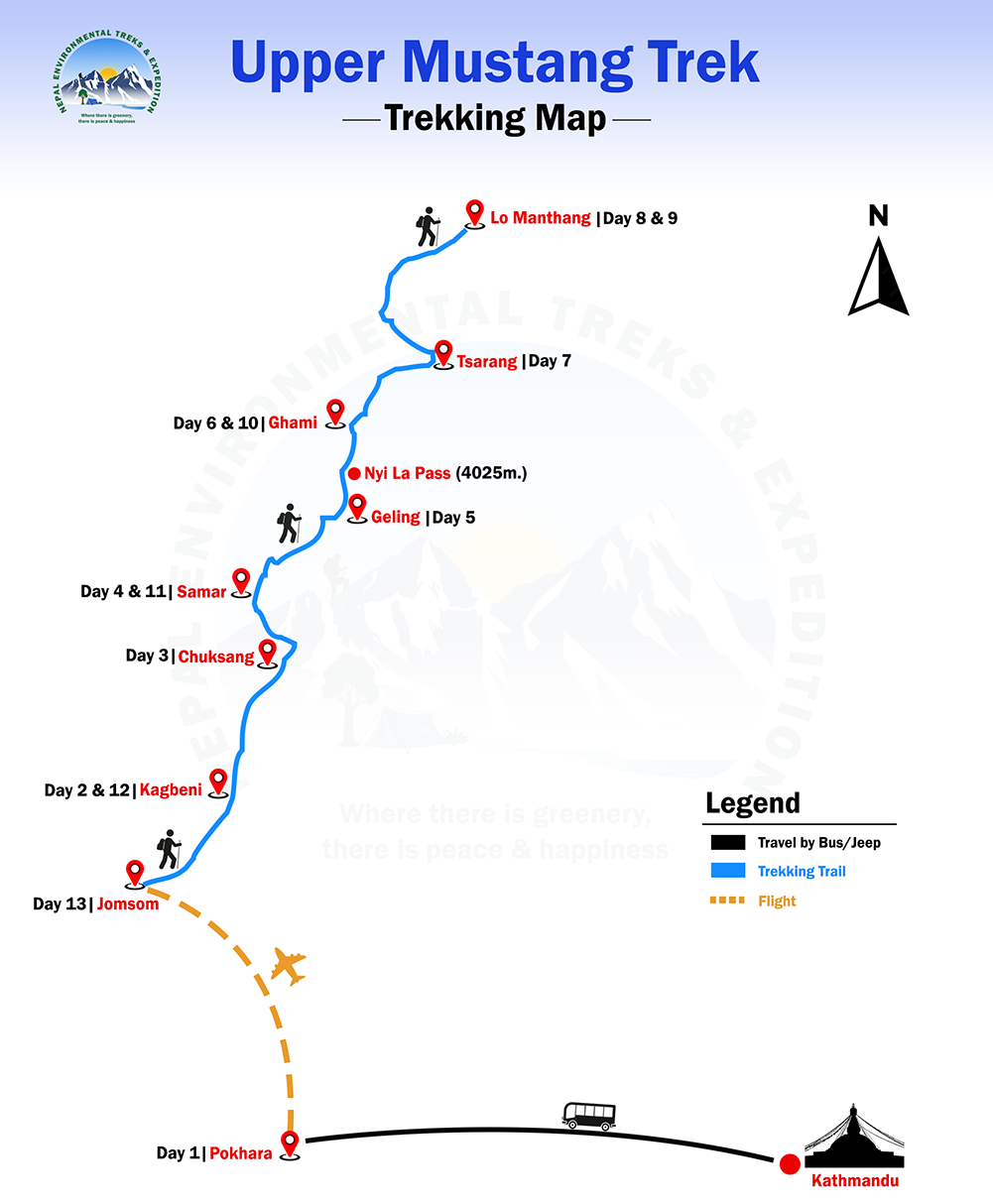
After early morning breakfast, you will be picked up from the hotel and taken to the tourist bus station. Drive from Kathmandu to Pokhara (914m.) takes about seven hours. The drive will take most of our morning time, leaving much of the afternoon to get a warm glimpse of Pokhara Valley and its beauty. If you choose to fly, you can reach Pokhara in 25 minutes. There are several flights from morning to afternoon available from Kathmandu to Pokhara.
Pokhara is the tourist's paradise with full of natural as well as cultural heritage sites such as lakes, caves, Buddhist monasteries and Hindu temples along with the magnificent views of Lamjung Himal, Annapurna, Dhaulagiri and many other mountain peaks. Stay overnight at hotel in Pokhara.
You take the spectacular early morning flight to Jomsom. The trail is quite barren with craggy rocks and sand and is mostly flat, which makes it very easy going. It is also very picturesque, with views of big peaks all around such as Dhaulagiri, Tukuche and Nilgiri, whilst to the south can be seen the entire Annapurna Massif. Stay overnight at lodge.
You trek right up to the river valley, but you use a combination of the high trail and the riverbank pathways. The trail then widens significantly revealing an endless stretch of sand. Chusang village is only about a 2hrs walk beyond Tangbe at the confluence of the Narshing Khola and the Kali Gandaki. Stay overnight at lodge.
The trek now leaves the valley and climbs steeply up a rocky alley to the village of Chele. From Chele you climb a steep spur and then continue ascending along the side of a spectacular steep canyon to a pass. Beyond the pass you descend on a pleasant trail to Samar, situated in a grove of poplar trees. Stay overnight at lodge.
You climb above Samar to a ridge and then descend into a large gorge past a chorten before entering another valley filled with juniper trees. You then cross a stream and after climbing to a pass, you descend along a ridge to Shyangmochen a tiny settlement with a few tea shops. The trail climbs gently from Shyangmochen and you enter another huge valley before descending to Geling with its extensive fields of barley. Stay overnight at lodge.
From Geling the trail climbs gently through fields, up to the center of the valley, passing above the settlement of Tama Gun and an imposing chorten. You then begin a taxing climb across the head of the valley to the Nyi La (4025m.). The descent from the pass is quite gentle and about half an hour further on we come to a trail junction; the right trail is the direct route to Tsarang, the left trail leads to Ghami. Ghami is a large white-washed village sheltered by overhanging cliffs. Stay overnight at lodge.
Today's walk is perhaps through the driest part of Mustang. Finally, you come to Tsarang, a large spread-out village at the top of the Tsarang Chu canyon. At the eastern end of the village are a huge dzong and a red Gompa which houses an excellent collection of statues and thangkas. Stay overnight at lodge.
You will spend part of the morning exploring the interesting village of Charang and its large monastery, before setting out for Lo Manthang (3840m.). You climb gently above the valley to a large isolated chorten that marks the boundary between Charang and Lo. The trail then broadens and eventually you get your first view of the walled city of Lo Manthang. The city has only one entrance so you circumambulate the wall to the gate on the north east corner. Stay overnight at lodge.
You can make a side trip exploring caves and villages, visiting Jhampa and Thupchen Gompas and short hike up to Tingkhar. Stay overnight at lodge.
You continue your journey on the highland route, crossing alpine meadows before dropping down a steep eroded alley to Dhakmar for lunch. After lunch, you walk through the pretty valley, climb to a ridge and descend from there back to Ghami. Stay overnight at lodge.
Leaving Ghami you begin to follow narrow winding path until you reach Geling crossing a small stream. Samar is a small village with terraces, Tibetan style houses, Mani walls, monastery, and prayer flags and here you find people following Tibetan life styles and traditions. Stay overnight at lodge.
Following a descending path you reach Chuksang crossing a suspension bridge over Kali Gandaki. You walk along the bank of Kali Gandaki with views of natural vegetation and apple orchards. Stay overnight at lodge.
Your trail passes through the bank of Kali Gandaki passing through Ekle Bhatti. Jomsom is the headquarters of Mustang. From here you can have access to the internet and banking facilities. Stay overnight at hotel.
The flight is a scenic one with panoramic views of Himalayan peaks, especially Annapurna, Dhaulagiri, Nilgiri etc. and Kaligandaki River. The flight to/from Jomsom happens only in the morning because of high wind in afternoon time. Stay overnight at hotel in Pokhara
After breakfast early morning, drive from Pokhara to Kathmandu that takes about seven hours. En route, you will enjoy the mountain views, green sceneries, rice terrace fields, vegetable fields and people being engaged in their daily life activities. If you choose to fly back to Kathmandu, it takes about 25 minutes. There are several flights from Kathmandu to Pokhara from morning to afternoon.
The trek usually takes 12 to 16 days, depending on the starting and ending points. The classic route begins with a short flight from Pokhara to Jomsom and then follows the Kali Gandaki River into the arid Mustang region. Most itineraries include Lo Manthang (the walled capital of Upper Mustang) as the main destination, and some extend further to Chhoser or the Tibet border. Because of road access in certain sections, itineraries can be adjusted to be shorter or longer, making it flexible depending on your time and interests.
The trek is considered moderately difficult. Unlike Everest or Annapurna treks, it doesn’t involve very high passes or extreme altitudes, as the maximum elevation is around 3,800–4,200m. However, the terrain is dry, dusty, and exposed to strong winds, which can make trekking tiring. The walking days are typically 5–7 hours, and while the altitude is lower than other Himalayan treks, the arid climate can be challenging. Good physical fitness and stamina are necessary, but the trek is achievable for anyone with prior trekking experience.
The trek is possible almost year-round, but the best seasons are spring (March–May) and autumn (September–November), when the weather is clear and pleasant. One unique aspect of Upper Mustang is that it lies in the rain shadow of the Annapurna range, so it can also be trekked during the monsoon (June–August). In fact, summer is a great time to witness green fields, local farming, and the famous Tiji Festival in Lo Manthang. Winter, however, can be harsh and many villagers migrate to lower regions.
The landscapes of Upper Mustang are unlike anywhere else in Nepal. Instead of green forests, trekkers encounter windswept valleys, eroded cliffs, deep canyons, caves carved into cliffs, and colorful rock formations in shades of red, orange, and ochre. The area is often compared to the Tibetan Plateau. Alongside the desert-like terrain, trekkers also enjoy views of Nilgiri, Annapurna, and Dhaulagiri peaks in the distance. The combination of stark Himalayan desert with snow-capped mountains makes it visually extraordinary.
Upper Mustang is one of the most culturally rich regions of Nepal. It was once part of the ancient kingdom of Lo, with Lo Manthang as its capital. The culture is deeply influenced by Tibetan Buddhism, and trekkers will encounter centuries-old monasteries, mani walls, chortens, and traditional mud-brick houses. The people of Mustang still practice Bon and Buddhist rituals, wear traditional dress, and celebrate vibrant festivals such as the Tiji Festival. Visiting Upper Mustang feels like stepping back in time, into a living museum of Tibetan culture.
Lo Manthang is the ancient walled city and cultural heart of Upper Mustang. Built in the 14th century, it is surrounded by fortifications and narrow alleyways that protect palaces, monasteries, and traditional houses. Today, it remains the cultural and political center of Mustang, where the King of Lo still resides, though only symbolically since monarchy was abolished in Nepal. For trekkers, Lo Manthang is the highlight of the journey—a place where ancient Tibetan traditions and architecture are still preserved in their original form.
The risk of altitude sickness is lower than treks like Everest or Annapurna because elevations in Upper Mustang are relatively moderate. The highest points are around 3,800–4,200m, which is manageable for most trekkers with proper pacing. However, altitude sickness can still occur, especially if you ascend too quickly. It’s important to stay hydrated, walk at a steady pace, and allow your body to acclimatize. Guides are trained to recognize symptoms and assist if needed.
Yes, the trek is generally safe. The trails are well-marked, and since the region is restricted, there are fewer trekkers, making it peaceful. Trekking with a licensed guide is mandatory, which adds a layer of safety and ensures proper communication with locals. The main challenges are strong winds, dusty trails, and remote locations where medical facilities are limited. Having travel insurance with evacuation coverage is highly recommended.
Nepal Environmental Treks & Expedition ensures you to provide a well planned itinerary for Upper Mustang trek. An experienced and highly professional climbing guide will be assigned to each climbing member. All necessary logistics will be taken care from our side. However, we expect to maintain good health and physical condition as well as well good mental preparation from your side.
Below is a list of equipment and clothing required for trekking. The necessity of these items depends on the type, altitude, timing and destination of trekking. Appropriate trekking gears are not only required for the comfort/pleasure of your trek but also to improve safety factor. Please have a look over these items in order to fully prepare and thoroughly enjoy the trekking.
General Items:
Daypack, Rucksack, Sleeping bag, Duffel bag, Walking Poles, walking boots, sandals, Toiletries (Soaps, Toilet papers, Sanitizers, toothpaste, tooth brush, etc.)
Clothing Items:
Thermal underwear, Down jacket, Shorts, Trekking trousers, Towels, Woolen gloves, Gaiters, Fleece jacket or Pullover, Wind/water proof jacket, Raincoat, Warm socks, buff
Sun-worn Items:
Sun hat, Sunglasses, Snow goggles, Sunscreen, Lip balm
Gadgets:
Headlamp, Flash light, Binoculars, Cameras (chargers and batteries),
Liquid/Snacks:
Water bottle/bladder, Water purification Iodine tablets, Energy bars and snacks
Medical Essentials:
First Aid Kit
Optional:
Altimeter, Compass, Binoculars, Books/magazines, GPS, Pocket knife, Candles (for lodges), Notebook with pencil/pen, etc
Additional items for camping trek:
Tent, Stove and fuel, Utensils for cooking, eating and drinking, sleeping mattresses
Note: We can also provide sleeping bag, down jacket, duffel bag, walking poles, and First Aid Kit in case if you don’t have one. These items are inclusive of total package price.
Nepal , Mustang Trek 17 Days
Nepal , Mustang Trek 22 Days
Nepal , Mustang Trek 24 Days