Find Your Tour
  • 34 Years Excellence
TripAdvisor Travelers' Choice Awards 2025

Langtang Trek

Based on 5 reviewsSee more reviews on TripAdvisor

Overview And Highlights

Trip Facts

Duration

10 Days

Trip Type

Lodge Trek

Grade

Moderate

Max. Elevation

3870 m.

Transportation

Bus / Jeep

Min. Group Size

1 or more

Best Season

Spring and Autumn

Langtang trek is one of the most popular trek in Nepal, known for its unique Tibetan and Tamang culture, alpine biodiversity and beautiful views of Langtang Himalayan range.

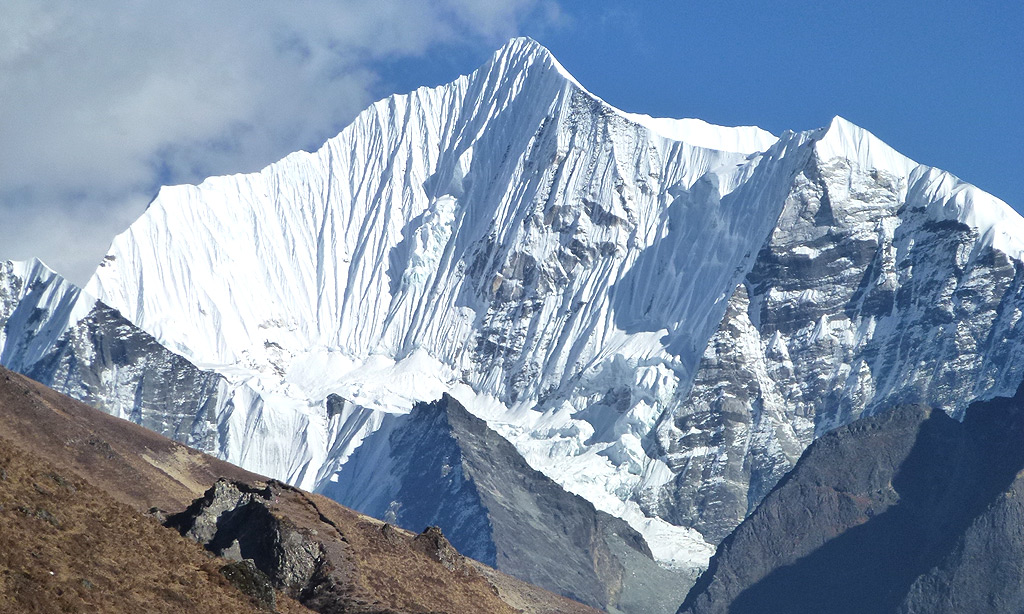
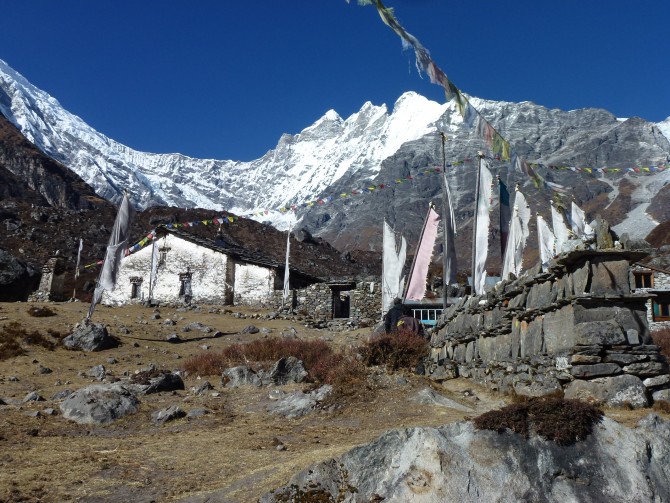
Langtang trek mostly occurs within Langtang National Park which is home to rich vegetation and diverse animal species such as Red Panda, Himalayan Black Bear and Ghoral. You will hike up to Kyanjin Gompa and from there explore Kyanjin Ri (4350m) and capture breathtaking views of Langtang mountains. You will also visit beautiful villages of Syabrubesi, Lama Hotel, Sherpa Gaon and especially Langtang Village which was completely destroyed by the 2015 earthquake.

Day to Day Itinerary

Accommodation

Hotel

Max Elevation

1400 m.

On your arrival at Tribhuvan International Airport, you will be met and welcomed by our airport representative. You will be greeted traditionally with flower garlands and then transfer to your hotel. In the afternoon, you can take a stroll around and visit shops. Stay overnight at hotel in Kathmandu.

Food/Meals

Breakfast/lunch/dinner

Accommodation

Lodge

Max Elevation

1460 m.

After early morning breakfast, drive from Kathmandu to Syabru Besi (1460m.) which takes about seven hours. You head north out of Kathmandu driving through scenic foothills and ridgeline vistas to Syabru Besi passing through Dhunche. Stay overnight at lodge.

Food/Meals

Breakfast/lunch/dinner

Accommodation

Lodge

Max Elevation

2470 m.

After breakfast trek from Syabru Besi (1460m.) to Lama Hotel (2470m.) takes about five and half hours. The first part of the trail crosses through Bhote Koshi and follows the Langtang Khola. Thereafter, your trek ascends gently to Rimche (2400m.) through Bamboo (1960m.) which lies at the bank of Langtang Khola. Stay overnight at lodge.

Food/Meals

Breakfast/lunch/dinner

Accommodation

Lodge

Max Elevation

3430 m.

Early morning trek from Lama Hotel to Langtang village (3430m.) via Ghora Tabela takes about six hours. The path ascends to Ghora Tabela [3000m], where there is a Nepalese army post. The trail continues to climb gently passing a few temporary settlements used by herders. Stay overnight at lodge.

Food/Meals

Breakfast/lunch/dinner

Accommodation

Lodge

Max Elevation

3870 m.

After breakfast, trek from Langtang Village to Kyangjin (3870m.) takes about three hours. The trail climbs gradually through small villages, yak pasture and small stream. The trail reaches Kyangjin which hosts a small monastery and a government-operated cheese factory. Stay overnight at lodge.

Food/Meals

Breakfast/lunch/dinner

Accommodation

Lodge

Max Elevation

3870 m.

This is a rest day at Kyangjin Gompa. You can visit the monastery and the cheese factory, walk up the moraine to see the spectacular ice faces and tumbling glaciers of Langtang Lirung or ascend Kyangjin Ri (4350m.), for a breathtaking panorama of the Langtang peaks. Stay overnight at lodge.

Food/Meals

Breakfast/lunch/dinner

Accommodation

Lodge

Max Elevation

2470 m.

Early morning trek from Kyangjin Gompa to Lama Hotel (2470m.) takes about six hours. From Kyangjin you retrace your route, following the Langtang Khola to Langtang village and on to Ghora Tabela. After lunch, continue a steep descent to Lama Hotel. Stay overnight at lodge.

Food/Meals

Breakfast/lunch/dinner

Accommodation

Lodge

Max Elevation

1460 m.

Morning trek from Lama Hotel to Syabru Besi via Sherpa Gaon takes about five hours. The upper part of the trail is more beautiful for the panoramic view of mountains and green hills. Then the trail drops steeply to Syabru Besi (1460m.). Stay overnight at lodge.

Food/Meals

Breakfast & Lunch

Accommodation

Hotel

Max Elevation

1400 m.

After breakfast, early morning drive from Syabru Besi to Kathmandu by bus takes about seven hours. You drive through terraced hills, forests, villages and rivers to Kathmandu.

Food/Meals

Breakfast

As per your flight schedule, our airport representative will transfer from your hotel to the airport for your final departure. 

Price includes the following services

a) Kathmandu

  • Airport pick-up and drop-off services by private vehicle
  • 2 night hotel accommodation with breakfast 
  • Farewell dinner in Kathmandu with live cultural performance at authentic Nepali restaurant on the last evening


b) Trekking

  • Trekking guide
  • One porter for every 2 trekking participants (1 porter carries 25 kilograms of luggage)
  • All meals three times a day (breakfast, lunch & dinner)
  • Accommodation in teahouses (lodges) during the trek
  • Trekking equipment: Sleeping bags, down jackets, duffle bags and trekking poles
  • Entry permit for Langtang National Park
  • Trekkers' Information Management System (TIMS) card
  • Land transportation from Kathmandu to Syabru Besi and from Syabru Besi to Kathmandu by bus/ jeep
  • Insurance and equipment for all guides and porters
  • First aid kit
  • Tax, VAT and our service charge
  • Rescue assistance (In case of emergency while trekking in mountains, we will organize prompt and professional rescue services. To arrange timely evacuation/rescue by helicopter, you must have insurance from a reliable international travel insurance company that covers both helicopter evacuation and medical treatment cost.)

Service Excludes

  • Personal expenses (telephone calls, internet, toiletries, battery recharge, laundry, all drinks including soft drinks, beers, and any alcoholic beverages)
  • Travel / Medical insurance
  • Tips for guide and porters
  • Lunch and dinner in Kathmandu
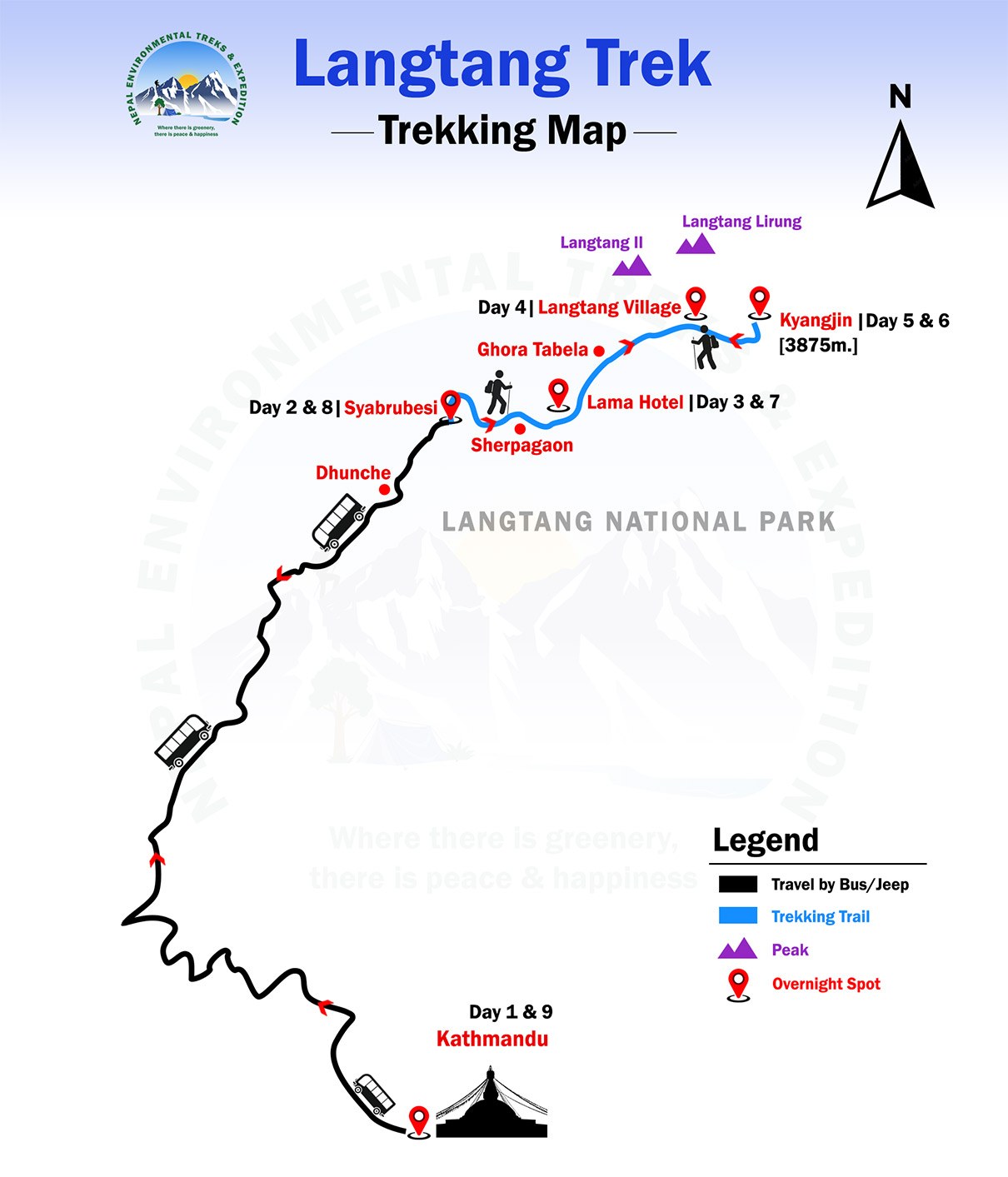
Explore the route

Altitude & route map

Select a preview to open a large, zoomable view.

Langtang Trek Altitude Graph

Route Map

Langtang Trek route map

Frequently Asked Questions for Langtang Trek

The Langtang Trek is generally rated moderate. The trails are well-defined and don’t require technical climbing, but you’ll still be walking 5–7 hours a day with plenty of uphill and downhill. The elevation gain is gradual, but you’ll reach heights of around 3870m. at Kyanjin Gompa, and can optionally ascend to over 4,800 meters at Tserko Ri. Trekkers should have decent fitness and some hiking experience, although first-timers in good health can also complete it comfortably with proper preparation.

A typical Langtang Trek takes about 7 to 10 days, including travel to and from the trailhead. The standard route starts in Syabrubesi, ascends through villages like Lama Hotel and Langtang Village, reaches Kyanjin Gompa, and returns via the same trail. Many trekkers add an extra day or two for acclimatization or side trips like Tserko Ri or Kyanjin Ri for breathtaking views.

The best seasons are spring (March to May) and autumn (September to November). Spring offers pleasant temperatures, blooming rhododendrons, and lush greenery, while autumn brings clear skies, stable weather, and jaw-dropping Himalayan views. Winter (December to February) is possible too, but expect snow and freezing nights. Monsoon season (June to August) is generally discouraged due to slippery trails, leeches, and obstructed views.

Langtang is incredibly diverse in terms of landscape. You’ll start trekking through subtropical forests, pass by thundering rivers, and walk through dense pine and bamboo groves. As you ascend, the terrain transforms into alpine meadows, glacial valleys, and towering snow-capped peaks like Langtang Lirung (7227m.). You’ll also see yaks grazing in the highlands, and if you're lucky, you might spot red pandas or Himalayan monals in the forest areas.

You’ll need two key permits:

  • Langtang National Park Entry Permit: Approx. NPR 3,000 for foreigners.
  • TIMS Card (Trekkers' Information Management System): Approx. NPR 2,000.

The Langtang region is well-equipped with teahouses, which are small family-run lodges offering simple rooms, basic amenities, and home-cooked meals. Rooms typically have twin beds, shared bathrooms, and solar-heated hot showers (sometimes at extra cost). Teahouses at higher elevations are more basic, but you’ll always find a warm dining area and friendly service.

Yes, especially beyond 3000 meters. The highest overnight stay is usually at Kyanjin Gompa (3870 m.), and optional side hikes go even higher. Altitude sickness symptoms can include headache, nausea, fatigue, and shortness of breath. To prevent AMS, walk slowly, hydrate well, and take an acclimatization day at Kyanjin before climbing higher. If symptoms worsen, descend immediately.

Langtang Valley is primarily inhabited by Tamang people, an ethnic group of Tibetan origin. You’ll encounter Buddhist monasteries, mani walls, prayer wheels, and chortens throughout the trail. Staying in family-run teahouses allows for a firsthand glimpse into rural Himalayan life. In Kyanjin Gompa, you can visit an ancient monastery and a local cheese factory built with Swiss assistance.

The Langtang region was one of the hardest hit by the 2015 earthquake, especially Langtang Village. However, the area has been rebuilt and is now safe for trekking. Many new and safer trails and teahouses have been constructed, and tourism has returned. Visiting the region today helps support continued recovery and honors the memory of those lost.

Nepal Environmental Treks & Expedition ensures you to provide a well planned itinerary for Langtang trek. An experienced and highly professional climbing guide will be assigned to each climbing member. All necessary logistics will be taken care from our side. However, we expect to maintain good health and physical condition as well as well good mental preparation from your side.

Additional Information

Below is a list of equipment and clothing required for trekking. The necessity of these items depends on the type, altitude, timing and destination of trekking. Appropriate trekking gears are not only required for the comfort/pleasure of your trek but also to improve safety factor.  Please have a look over these items in order to fully prepare and thoroughly enjoy the trekking. 

General Items:

Daypack, Rucksack, Sleeping bag, Duffel bag, Walking Poles, walking boots, sandals, Toiletries (Soaps, Toilet papers, Sanitizers, toothpaste, tooth brush, etc.)

Clothing Items:

Thermal underwear, Down jacket, Shorts, Trekking trousers, Towels, Woolen gloves, Gaiters, Fleece jacket or Pullover, Wind/water proof jacket, Raincoat, Warm socks, buff   

Sun-worn Items:

Sun hat, Sunglasses, Snow goggles, Sunscreen, Lip balm

Gadgets:

Headlamp, Flash light, Binoculars, Cameras (chargers and batteries),  

Liquid/Snacks:

Water bottle/bladder, Water purification Iodine tablets, Energy bars and snacks

Medical Essentials:

First Aid Kit 

Optional:

Altimeter, Compass, Binoculars, Books/magazines, GPS, Pocket knife, Candles (for lodges), Notebook with pencil/pen, etc 

Additional items for camping trek:

Tent, Stove and fuel, Utensils for cooking, eating and drinking, sleeping mattresses

Note: We can also provide sleeping bag, down jacket, duffel bag, walking poles, and First Aid Kit in case if you don’t have one. These items are inclusive of total package price. 

Client Reviews

Book Now Inquiry

Similar Packages

Enjoy the popular trekking and tour packages in Nepal Himalayas. 2026.

WE ARE MEMBER OF

  • Tourism Department
  • Trekking Agencies Association of Nepal
  • Nepal Mountaineering Association
  • Kathmandu Environmental Education Project
  • Himalayan Rescue Association, Nepal
  • VTOFNEPAL
  • Thamel Tourism Development Council